
Help physicians in identifying a diagnosis as a diagnostic medical sonographer.
What is Diagnostic Medical Sonography?
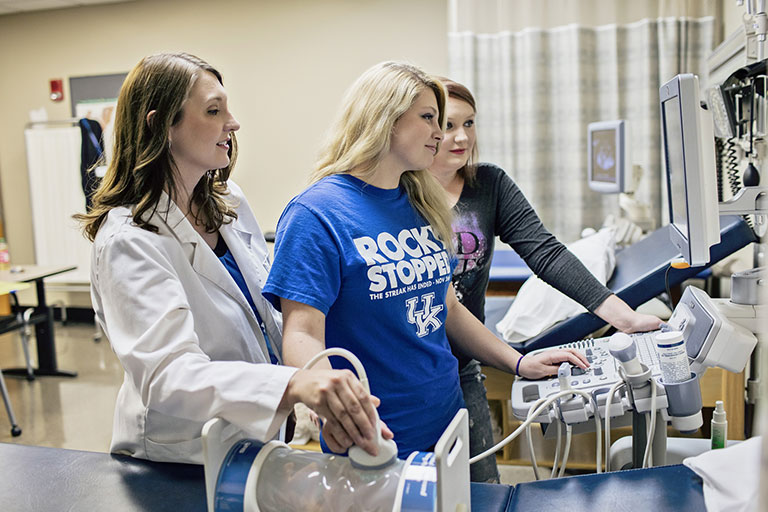
Diagnostic Medical Sonography is a skilled healthcare profession that uses specialized imaging equipment to visualize internal body structures for medical diagnosis under physician supervision. The general track prepares graduates to perform abdominal, small parts, and OB/GYN sonograms, with training in sectional anatomy, ultrasound instrumentation, and imaging.
Getting Started
What are my degree, diploma, and certificate options?
How Do I Pay For This?
Worry no more. With the lowest tuition in Kentucky, financial aid options, and a helping hand to guide you through the application process, SCC has you covered. SCC will help you reach your goals at a price that won't break the bank.
Where do I start?
Admission to the Diagnostic Medical Sonography (DMS) Program is selective. To be considered, applicants must:
- Apply to SCC
- Submit official transcripts from all colleges attended (outside KCTCS)
- complete all required general education and supportive courses with a grade of a “C” or better prior to entering the program
- Take the ACT or SAT
- Attend a preadmission conference
- Apply for program admission
Preference is given to:
- Applicants with an ACT score of 21 or better or the equivalent on the SAT
- Applicants who have graduated or are in their final semester of a two-year accredited, clinically based Allied Health Program or have a minimum of AAS in clinically related field
Prerequisite courses must be completed with a grade of “C” or higher before applying.
- MAT 150 College Algebra (or higher-level quantitative reasoning course)
- ENG 101 Writing I
- Select one of the two options
- BIO 135 Basic Anatomy and Physiology with Laboratory (NOT Preferred)
- BIO 137 Human Anatomy & Physiology I & Physiology I and BIO 139 Human Anatomy & Physiology II (PREFERRED)
- PHY 152 Introductory Physics II (PHY 151 or PHY 171 also accepted)
- AHS 120 Medical Terminology (AHS 115 also accepted)
- Select one of the three options
- NAA 100 Nursing Assistant Skills I and CPR 100 CPR of Healthcare Professionals (PREFERRED)
- MNA 100 Medicaid Nurse Aide & CPR 100 CPR for Healthcare Professionals
- HST 104 Health Care Basic Skills, or be a graduate of an allied health program
- One Heritage/Humanities course
- One Social/Behavioral Science course
See the Diagnostic Medical Sonography – AAS plan above for full degree requirements after admission.
Section 1 (all Students): ACT/SAT
| ACT Composite | SAT | Points |
|---|---|---|
| <=20 | <=1050 | 0 |
| 21-22 | 1060-1120 | 4 |
| 23-24 | 1130-1190 | 7 |
| 25-26 | 1200-1250 | 10 |
| 27-28 | 1260-1320 | 13 |
| 29-30+ | 1330-1380+ | 16 |
Section 2: Admission requirements (Grade of C or better required)
| Course | Points for a Grade of A |
Points for a Grade of B |
Points for a Grade of C |
|---|---|---|---|
| MAT 150 College Algebra (or higher) | 5 | 3 | 1 |
| ENG 101 Writing I | 3 | 2 | 1 |
| Heritage/Humanities | 3 | 2 | 1 |
| Social/Behavioral Sciences | 3 | 2 | 1 |
| BIO 137 A&P I with Lab | 6 | 3 | 1 |
| BIO 139 A&P II with Lab | 6 | 3 | 1 |
| PHY course (151/152/171) | 6 | 3 | 1 |
| Medical Terminology (AHS 115/120) | 3 | 2 | 1 |
| NAA 100 Nursing Assistant Skills | 3 | 2 | 1 |
If you have taken CPR 100 Healthcare Professionals you will earn 1 point.
Section 3 Preference Factors
You will earn 5 points if you have graduated or are in your final semester of a two-year accredited, clinically based Allied Health Program or have a minimum of AAS in a clinically related field.
Tie Breakers
- ACT score/ SAT score direct comparison
- Science GPA (BIO 137, BIO 139, PHY Course)
- Completion of all General Education Courses
- Have an AAS or Higher Degree in related field
- Veterans or active-duty military personnel
Preadmission Conference
What Else Do I Need to Know?
Accreditation
NOTICE: The Diagnostic Medical Sonography program is pending accreditation by the Commission on Accreditation of Allied Health Education Programs (CAAHEP), upon the recommendation of the Joint Review Committee on Education in Diagnostic Medical Sonography (JRC-DMS).
Commission on Accreditation of Allied Health Education Programs
9355 - 113th Street N, #7709
Seminole, FL 33775
(727) 210-2350
www.caahep.org
Field Licensure Requirements
Upon completion of the program, students must pass the American Registry of Radiologic Technologists (ARRT) Sonography exam to become certified. You can find more information on the ARRT website.
Additional Information
Diagnostic Medical Sonography involves the provision of direct care for individuals and is characterized by the application of verified knowledge in the skillful performance of Diagnostic Medical Sonography technical functions.
Therefore, all applicants should possess:
- Sufficient visual acuity for the observation necessary for patient assessment and care.
- Sufficient auditory perception to receive verbal communication from patients and members of the health team and to assess the health needs of people through the use of monitoring devices (e.g., cardiac monitors, biomedical equipment, fire alarms, etc.).
- Sufficient gross and fine motor coordination to respond promptly and to implement the skills, including the manipulation of equipment, positioning and lifting patients required in meeting health needs related to Diagnostic Medical Sonography.
- Sufficient verbal and non-verbal communication skills (speech, reading, and writing) to interact with patients and professional personnel.
- Sufficient intellectual and emotional functions to plan and implement care for individuals.
Length of Program
You can earn an Associate in Applied Science degree in two years if you maintain full-time status.
This information should not be considered a substitute for the KCTCS Catalog. You should always choose classes in collaboration with your faculty advisor to ensure that you meet all degree requirements.
